


Your shopping cart is empty!
Sweet pepper "Kasia"
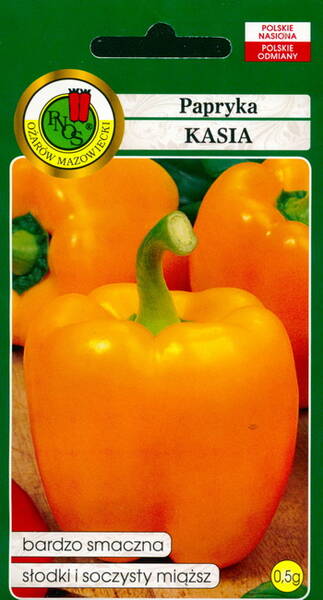
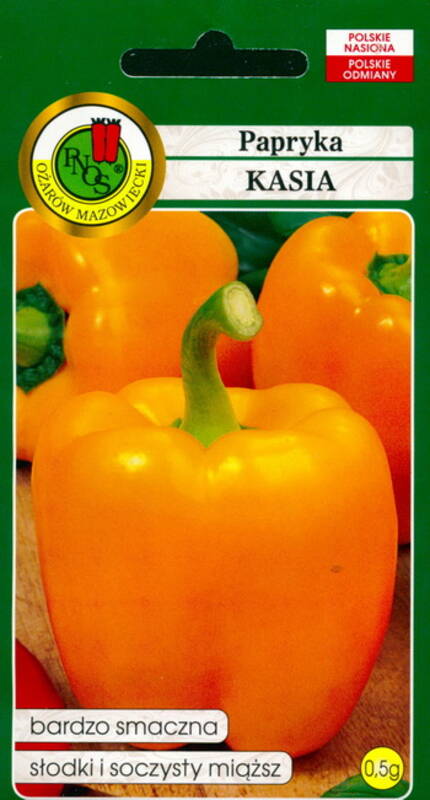
Sweet Pepper "Kasia".
Large, yellow, and thick-walled!
An early-ripening variety (75-80 days from germination to technical maturity), suitable for both greenhouses and open ground.
Variety Characteristics:
* Fruits: Blocky (cuboid), smooth, glossy. Color — intense yellow.
* Size: Weight 190-220 g, wall very thick — 8-10 mm.
* Taste: Delicate with a strong aroma. Excellent flavor quality.
* Plant: Medium height (60-70 cm), standard type. Does not require staking or pruning in open ground.
GUIDE: Agrotechnics of Sweet Pepper (Capsicum annuum).
1. Sowing and Seedlings.
Sow 10-12 weeks before planting out (early March for Northern Europe).
Sowing depth 0.5 cm. Optimal germination temperature +25..+30°C (sprouts in 7-15 days).
Tip: Peppers have a weak root system. It is better to grow them without pricking out (repotting), sowing directly into 0.5 L pots. If pricking out, do so at the cotyledon stage.
2. Temperature Regime for Seedlings.
Sunny days: +22..+28°C.
Cloudy days: +18..+20°C.
Night: +15..+17°C.
Harden off seedlings 10-12 days before planting (reduce temperature and watering).
3. Planting Out (Estonia context).
Seedling age: 60-70 days.
Dates:
* Heated greenhouse: End of April.
* Unheated greenhouse: Mid-May.
* Open ground: Early June.
Spacing: 70-95x40-45 cm. Soil should be fertile and slightly acidic.
4. Care.
Watering: Every 5-7 days. Do not allow drying out or waterlogging! Sharp fluctuations in moisture lead to flower/fruit drop.
Feeding: Complex fertilizer every 2-3 weeks. Be careful with nitrogen (excess promotes foliage over fruit).
Pruning: In greenhouses, train plants to 1-2 stems and tie them up. Remove the "crown bud" (the first flower at the main fork).
Large, yellow, and thick-walled!
An early-ripening variety (75-80 days from germination to technical maturity), suitable for both greenhouses and open ground.
Variety Characteristics:
* Fruits: Blocky (cuboid), smooth, glossy. Color — intense yellow.
* Size: Weight 190-220 g, wall very thick — 8-10 mm.
* Taste: Delicate with a strong aroma. Excellent flavor quality.
* Plant: Medium height (60-70 cm), standard type. Does not require staking or pruning in open ground.
GUIDE: Agrotechnics of Sweet Pepper (Capsicum annuum).
1. Sowing and Seedlings.
Sow 10-12 weeks before planting out (early March for Northern Europe).
Sowing depth 0.5 cm. Optimal germination temperature +25..+30°C (sprouts in 7-15 days).
Tip: Peppers have a weak root system. It is better to grow them without pricking out (repotting), sowing directly into 0.5 L pots. If pricking out, do so at the cotyledon stage.
2. Temperature Regime for Seedlings.
Sunny days: +22..+28°C.
Cloudy days: +18..+20°C.
Night: +15..+17°C.
Harden off seedlings 10-12 days before planting (reduce temperature and watering).
3. Planting Out (Estonia context).
Seedling age: 60-70 days.
Dates:
* Heated greenhouse: End of April.
* Unheated greenhouse: Mid-May.
* Open ground: Early June.
Spacing: 70-95x40-45 cm. Soil should be fertile and slightly acidic.
4. Care.
Watering: Every 5-7 days. Do not allow drying out or waterlogging! Sharp fluctuations in moisture lead to flower/fruit drop.
Feeding: Complex fertilizer every 2-3 weeks. Be careful with nitrogen (excess promotes foliage over fruit).
Pruning: In greenhouses, train plants to 1-2 stems and tie them up. Remove the "crown bud" (the first flower at the main fork).
Life cycle: perennial plant grown as an annual crop.
Growing conditions: in protected soil (greenhouses, film tunnels or film shelters).
Seeds: 120-200 seeds per 1 g.
Sowing: 10-12 weeks before planting seedlings. Sow in a heated greenhouse (heated room) in seed boxes to a depth of 0.5 cm, then cover with soil. Use a loose, moisture-intensive substrate. The crops are covered with glass or film on top.
Germination: after 7-15 days at a temperature of +25..+30°C.
Growing seedlings: can be grown with or without picking. Since the regenerative ability of the root system of peppers is weak, it is more advisable to grow without picking, sowing the seeds immediately in pots of about 0.5 liters. When grown with picking, seedlings are picked in the cotyledonous leaf phase into pots with a diameter of 8x8 or 10x10 cm. The temperature is maintained at +22..+28°C on sunny days, +18..+20°C in cloudy weather, +15.. +17°С at night. During the growing period, 2 feedings are carried out with organic or complex mineral fertilizers. Before planting in open ground, the seedlings are hardened off (watering is reduced for 10-12 days, ventilation is increased, the temperature is reduced to +16°C during the day, and maintained within +11..+13°C at night).
Planting: seedlings are planted at an age of at least 60-70 days.
Approximate dates for Estonia: in a heated greenhouse - at the end of April; in unheated - in mid-May; in open ground - in early June.
Before planting, apply complete mineral fertilizer (40-60 g per 1 m2).
Planting pattern 70-95x40-45 cm, depending on the variety and place of cultivation. After planting, the plants are watered and the soil around them is mulched.
Soil: light, fertile, permeable, slightly acidic.
Temperature: pepper is a very heat-loving plant and requires high light levels. The optimal daytime temperature in sunny weather is +24..+28°C, in cloudy weather +22..+24°C, +16..+17°C at night.
Watering: pepper requires constant soil moisture, without waterlogging or drying out. Sharp fluctuations in soil moisture lead to the death of flowers and young ovaries. Watering is carried out at intervals of 5-7 days.
Nutrition: feed once every 2-3 weeks with complex mineral fertilizer. When there is an excess of nitrogen in the soil, the vegetative mass of plants develops strongly to the detriment of fruiting, so nitrogen-containing fertilizers should be applied carefully.
Care: systematic loosening, weeding, fertilizing and irrigation. In open ground, as a rule, plants are not shaped. When grown in protected soil, all shoots are removed up to the first (crown) bud, then the plants are tied to a trellis or stakes by one, more powerful shoot, the rest are collected with a circular garter.
Flowering: 70-80 days after germination.
Fruiting: technical ripeness occurs 100-120 days after emergence; biological maturation requires another 15-20 days.
Pörkölt: the soul of the Hungarian steppes.
Pörkölt is not just a meat stew; it is a symbol of the Hungarian culinary spirit. Unlike the famous goulash, which often balances on the edge of being a soup, pörkölt is a self-sufficient main course. Its essence lies in the "pörkölni" technique — roasting the meat until it begins to caramelize in a thick onion sauce. Secret ingredients:
-
Meat: 1 kg (beef, pork, or lamb with slight marbling).
-
Onions: 3–4 large bulbs (it is the onion that creates that legendary thickness of the sauce).
-
Hungarian paprika: 3 tbsp (use only high-quality sweet paprika).
-
Fat: 2 tbsp of lard (the traditional choice) or vegetable oil.
-
Vegetable accent: 1 green pepper and 1 ripe tomato (for a subtle acidity).
-
Spices: salt, a pinch of caraway seeds, and 2 cloves of garlic.
The art of creation.
-
Onion base: Heat the fat in a heavy-bottomed pan or cauldron. Sauté the finely chopped onions over low heat until golden. The onions should become soft, almost turning into a paste.
-
The paprika ritual: Remove the pan from the heat. Stir the paprika into the warm fat quickly. This is a critical moment: the paprika must release its aroma into the fat but not burn, otherwise the dish will be bitter.
-
Searing the meat: Add the diced meat. Return to the heat, add salt, caraway, and garlic. Roast until the meat is sealed on all sides.
-
Patience: Cover with a lid and simmer over minimum heat. The meat should stew in its own juices. If there is not enough moisture, add hot water literally a tablespoon at a time.
-
Completion: 20 minutes before it's done, add the chopped tomato and pepper. The pörkölt is ready when the meat falls apart into fibers and the sauce has become thick, glossy, and homogeneous.
Important: Authentic pörkölt is never thickened with flour. The required consistency is achieved solely through the correct ratio of onions, fat, and slow simmering.
Why is this worth cooking?
This dish is the embodiment of gastronomic refinement and historical heritage. It combines the impeccable quality of ingredients with Europe's strict agricultural tradition. In every bite, you can feel the richness of flavors and respect for the product.
Serve pörkölt with traditional Hungarian dumplings — nokedli — or with boiled potatoes sprinkled with fresh herbs.
: buy in Europe